Last updated: 24 October 2026
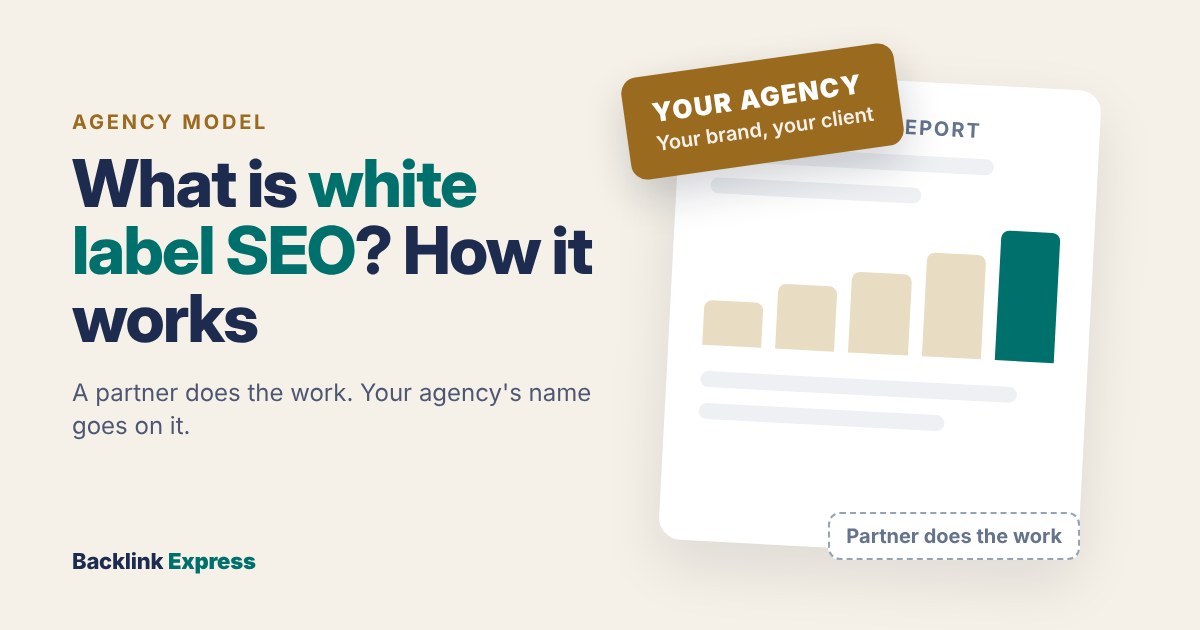
White label SEO is when your agency sells SEO under its own brand while a third-party provider does some or all of the work behind the scenes. You own the client, the price and the relationship; the provider fulfils the work and stays invisible.
That definition is the easy part. Here is the part most guides skip: white label SEO is a fulfilment model, not a strategy. Outsource the execution if you need to. Never outsource the strategy, the client’s accounts or the list of links built in your name, because when something goes wrong, your brand takes the hit and your client’s site takes the penalty.
Below: how the model works step by step, who it suits, the real pros and cons, the risks sales pages leave out, what it costs, and how to judge a provider fast.
What is white label SEO?
“White label” means a product or service made by one company and sold under another company’s brand. Supermarket own-brand cereal is white label. So is the SEO package a web design agency sells when a specialist team actually runs it.
In SEO, the arrangement has three parties:
- The provider does the work: audits, keyword research, on-page fixes, content, link building, local listings, reporting.
- Your agency sells the service, sets the price, manages the client and presents the results under your logo.
- The end client deals only with you and pays you.
You will also see it called reseller SEO, private label SEO or outsourced SEO fulfilment. The terms overlap. The defining feature is the branding: the client never sees the provider’s name.
How does white label SEO work?
Every provider wraps it differently, but the workflow is the same underneath:
- You sell and scope. You agree goals, locations, deliverables and budget with the client under your brand.
- You brief the provider. You pass on the client’s goals, competitors, brand rules and access to analytics, Search Console and the CMS.
- The provider audits and plans. Usually a technical audit, keyword map and a monthly work plan.
- The provider fulfils. Content gets written, pages optimised, citations built, links placed.
- You check the work. This is the step lazy resellers skip. You read the content, open the links and confirm the changes before the client sees anything.
- You report under your brand. Reports arrive unbranded or already in your logo and colours, often through a dashboard on your own subdomain.
- You bill the client. You pay the provider a wholesale rate and keep the difference.
The split of responsibility is where agencies get into trouble, so make it explicit:
| Area | Who should own it | Why |
|---|---|---|
| Client relationship and pricing | Your agency | This is the business you are building. |
| SEO strategy and priorities | Your agency (provider advises) | If the provider sets strategy, you are a middleman with a logo. |
| Google Search Console, Analytics, Business Profile, CMS | The client, with you as admin | Whoever owns the accounts controls the exit. Give the provider user access, not ownership. |
| Execution: audits, content, on-page, links | The provider | This is what you are paying for. |
| Quality check before delivery | Your agency | The client holds you accountable, not the provider. |
| The full list of links built | Your agency, in writing, every month | Links built in your name are your risk. |
On access: Search Console lets an owner grant “full” or “restricted” user permissions without handing over ownership. Google’s own Search Console permissions guide explains the levels. Use them.
Services or software: the two delivery models
“White label SEO” covers two different products, and mixing them up leads to bad buying decisions.
| White label SEO services | White label SEO software | |
|---|---|---|
| What you get | A team that does the work | A rebranded platform: audits, rank tracking, dashboards, reports |
| Who does the SEO | The provider | Your team |
| Best for | Agencies without SEO staff, or at capacity | Agencies with SEO skills that want branded tools and client portals |
| Main risk | Quality and link practices you cannot see | Paying for software your team does not have time to use |
Many agencies use both: branded reporting software plus outsourced fulfilment for the tasks they cannot staff, most often content and link building.
Who uses white label SEO?
The model fits agencies that already have clients asking for SEO and no team to deliver it:
- Web design and development agencies whose launch clients ask “can you get us ranking?”
- PPC and social media agencies that want to keep the whole marketing budget in one place.
- SEO agencies at capacity that outsource specific tasks, such as content or links, rather than whole accounts.
- Freelance consultants who sell strategy and need hands for execution.
It suits agencies selling to small and local businesses especially well, because those accounts need repeatable packages more than custom strategy.
Pros and cons of white label SEO
| Pros | Cons |
|---|---|
| Add SEO revenue without hiring a team first | Margins are thinner than they look once you count your own time |
| Scale up or down as clients come and go | You carry the reputation risk for work you did not do |
| Access specialists (technical, local, content, links) you could not hire one by one | Less control over methods, timing and quality |
| No separate tool stack to buy for every task | Dependency: switching providers mid-contract is painful |
| Your team stays focused on sales and client service | Your team may never learn SEO well enough to spot bad work |
That last con is the dangerous one. If nobody in your agency can read an audit or judge a link, you cannot run step 5 of the workflow, and you are trusting the provider blind.
The risks white label sales pages leave out
After working in SEO and link building since 2012, my view is simple: most white label failures are not about effort. They are about risk the agency never knew it was carrying. Five to watch:
1. Link building done in your name
Links are where cheap providers cut corners, because the client rarely checks. Google’s spam policies define link spam as links created “primarily for the purpose of manipulating search rankings,” and list buying or selling links for ranking purposes as an example. The same policy says paid links are fine when they are marked with rel="nofollow" or rel="sponsored", and Google’s link attribute guide says sponsored is preferred for paid placements. If you need a refresher on how link attributes behave, read our guide to dofollow and nofollow links.
The practical rule: demand every live URL every month, with the site’s traffic and the link attribute. If a provider will not name the sites, walk. Private blog networks (PBNs) and hidden site lists are the classic red flags.
2. The client’s site carries the penalty, not the provider
Google is blunt about this in its guide to hiring an SEO: if an SEO creates deceptive content on your behalf, “your site could be removed entirely from Google’s index.” The same page says “No one can guarantee a #1 ranking on Google.” A provider promising guaranteed rankings has already failed your first check.
3. Account ownership and the exit
If the provider created the client’s Business Profile or owns the Search Console property, leaving them gets messy. Keep ownership with the client and yourself from day one.
4. Client poaching
Some providers contact end clients directly, or show up in report footers and email headers. Get a non-solicitation clause in writing and check that reports, dashboards and invoices carry nothing of theirs.
5. Mass-produced AI content
Cheap content is easy to produce now. Content that is accurate, edited and written for the client’s customers is not. Ask who writes, who edits and who fact-checks, and read the first five pieces yourself.
For the wider picture, our breakdown of SEO risks worth taking and the ones to avoid covers where the line sits.
How much does white label SEO cost?
Pricing comes in three shapes: a monthly retainer per client, a fixed price per task (an audit, an article, a citation batch) or a price per link. Entry-level monthly packages advertised on the US results page we checked on 24 October 2026 started at roughly $150 to $450 per client. Competitive or national campaigns cost far more.
The number that matters is your margin, and it is smaller than the provider’s sales page implies. A worked example with stated assumptions:
| Line | Amount (monthly, one client) |
|---|---|
| What you bill the client | $1,000 |
| Provider’s wholesale fee (assumed) | $500 |
| Your account management, QA and reporting: 4 hours at an assumed internal cost of $40/hour | $160 |
| Real gross margin | $340 (34%, not the 50% it first appears) |
Change the inputs to your own numbers. If quality problems push your review time to 8 hours, the margin falls to $180, or 18%. For package-level pricing and how providers structure it, see our guide to white label SEO pricing and services.
How to judge a white label SEO provider
There is no single best white label SEO company. The best one is the one that passes these checks for your clients’ niche and budget:
- Proof: case studies or agency references in niches like yours.
- Who does the work: in-house staff or subcontractors, and where.
- Exact deliverables: what is included each month, in writing.
- Link transparency: every live URL, the site’s traffic and the
relattribute, reported monthly. - Ownership: the client owns accounts, content and data if the contract ends.
- Branding: reports and dashboards fully in your brand, with a non-solicitation clause.
- Terms: turnaround, revision limits and cancellation notice period.
Then run a pilot on one or two clients before you move the rest. Measure how much of your time their work eats. For named providers, read our reviews of white label SEO companies, and if you only need links, compare white label link building agencies separately.
Does white label SEO still make sense with AI search?
Yes, and the reason is in Google’s own documentation. Google’s page on AI features and your website says “the best practices for SEO remain relevant” for AI Overviews and AI Mode, with “no additional requirements” to appear in them. The AI Overview for “white label seo” on 24 October 2026 cited pages from SEOReseller, FatJoe, ALM Corp, Search Atlas and Semify, four of them pages that also rank on page one of the organic results.
What has changed is what clients ask for. They now want to know whether they show up in AI answers. A provider that only reports rankings and traffic is behind; ask how they track AI Overview and AI answer visibility.
When white label SEO is the wrong call
Use this rule. White label SEO makes sense when you have at least a few clients already asking for SEO, someone in-house who can judge the work, and a provider that passes the checks above. It is the wrong call when:
- Nobody on your team can spot a bad audit or a bad link.
- Your clients need deep custom strategy, not a repeatable package.
- You are selling SEO only to stop clients leaving, with no plan to deliver real results.
In those cases, hire one senior SEO first or refer the work out openly. A referral fee is better than a client you lose because of work you could not check.
If link building is the part of white label you want to control directly, pick the sites yourself, see their traffic and price before you order, and keep every URL on record. Browse vetted publishers on Backlink Express.